



Culture
Film ReviewThe Price of the Horse: Nolan's Odyssey and the Race We Keep Running
By Vika
·Christopher Nolan has been making variations on the same anxious movie for twenty-five years. His films believe in people and fear what people will do with the tools they build. His Batman pictures, taken together, form a course in how a city falls apart: a secret army sets out to cleanse Gotham by force, then the Joker arrives to burn money for the fun of it, then Bane hands the mob a revolution and a mask to hide behind. Inception turned a crew of con men into heroes for slipping into a sleeping man's head and planting an idea he would swear was his own. Interstellar grieved for a human race that had quit dreaming big. Tenet and Oppenheimer looked straight at the machinery of self-destruction. Anyone who has gone to the movies since 2000 has been living in Nolan's world.
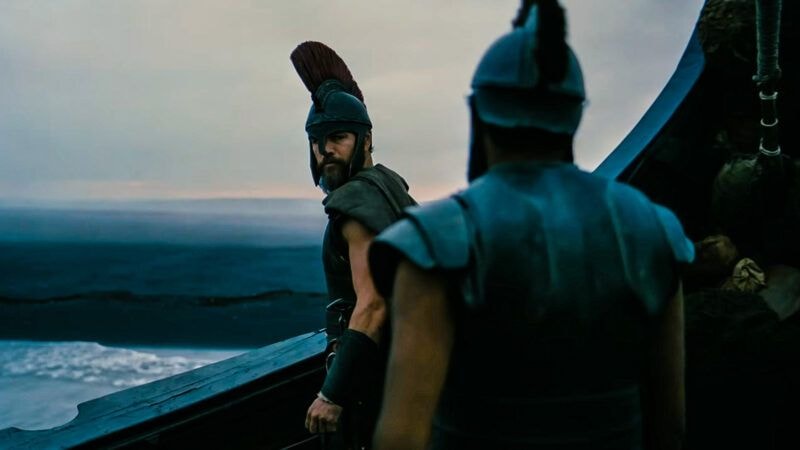
Now he has returned to the oldest road trip in Western literature. Christopher Nolan's The Odyssey opened on July 17 with Matt Damon as Odysseus, and anyone who read Homer in school will recognize the stops along the way. The whirlpool is here, and it is terrifying. So is the cyclops in his cave. And so is the Trojan Horse, the trick that won the war and cost its inventor ten years of trying to get home.
The horse is where Nolan shows his hand. He leaves it beached on the sand where the Greek camp used to be, looking less like a trap than a trophy, as if the Greeks finally broke and sailed away. The Trojans drag it inside. Then the soldiers climb out, and what follows plays less like a victory than a massacre.
Nolan has staged this con before. Inception is a Trojan Horse movie in a nice suit, a heist that depends on the target accepting the intruder as a gift, and audiences cheered the thieves when they pulled it off. The Odyssey asks what becomes of the thief afterward. Odysseus joins a family of Nolan heroes who lose time trying to get back to the people they love: Dom Cobb aching to see his children in Inception, Cooper in Interstellar watching his kids grow up on a video screen. Cobb spins a top to find out whether he has made it home. Odysseus makes it home and finds a harder question waiting for him there.
Homer ends his poem with a win. Odysseus kills the suitors and takes back his throne. Nolan ends his film with guilt, circling back to Troy's last night and presenting the famous trick as mass killing dressed up as tactics. Still disguised as a beggar, Odysseus talks to Penelope through a screen door and admits that winning the war meant killing innocents. Damon plays it without self-pity. Athena is rethought as well. The woman guiding him turns out to be a projection of the goddess, which leaves open the possibility that the voice he credited to heaven was his conscience all along.
Some classicists object to these changes. Others point out that the seed is already in Homer. In the poem, when a blind singer performs the story of the horse at a banquet, Odysseus hides his face and weeps, unable to hear his own cleverness praised. Nolan takes those tears seriously and builds a movie around them.
At its center, the film is about trust. In the ancient world, welcoming a stranger was sacred law, and Nolan connects the horse to a betrayal of that duty, so the most famous trick in literature becomes the thing Odysseus cannot forgive himself for. Characters speak throughout of the Sea Peoples, raiders who ignore Zeus's law, and near the end Odysseus tells Penelope the truth: the Greeks became those raiders. The film suggests that a society which admires the con man will struggle to remain a society.
The resemblance to Oppenheimer is hard to miss. One critic describes the film as the story of a brilliant man whose invention ends a long war, wins him applause, and leaves him haunted, before revealing he means Odysseus. SlashFilm reads Dunkirk, Oppenheimer, and The Odyssey as a loose trilogy: the first celebrates violence, the second questions the science behind it, and the third deals with the guilt of having used it.
The pattern the film traces is older than any of these movies. Rome conquered to protect its borders and kept conquering. The great powers of 1914 raced to build battleships and draw up mobilization plans, and the plans carried them into catastrophe. The Second World War ended with a race to split the atom. The Cold War stacked warheads by the thousands on the theory that the other side might stack more. Each generation builds its own horse and tells itself the same thing: we have to win, and we have to win first.
Today the horse is the AI race. Countries and companies compete to build ever more capable artificial intelligence, and the argument for speed is that slowing down hands the advantage to someone else. The film takes no side in that debate. It poses the question every competitor faces before the starting gun: what are you willing to break to get there first?
The Odyssey offers no answer, and a movie is not obliged to supply one. It gives us Odysseus, home at last, carrying Troy on his back. It proposes that a victory is measured by whether one can live with it afterward, and whether the whole story could be told at one's own kitchen table without a screen door in the way. That is a great deal to ask of a summer blockbuster, and Nolan asks it with remarkable craft.
The Odyssey (2026): 5/5 stars.
Have you seen it? Tell me where it left you in the comments, and follow @vikasfinds on Instagram for a new Thinking Wednesday topic every week.
Culture